
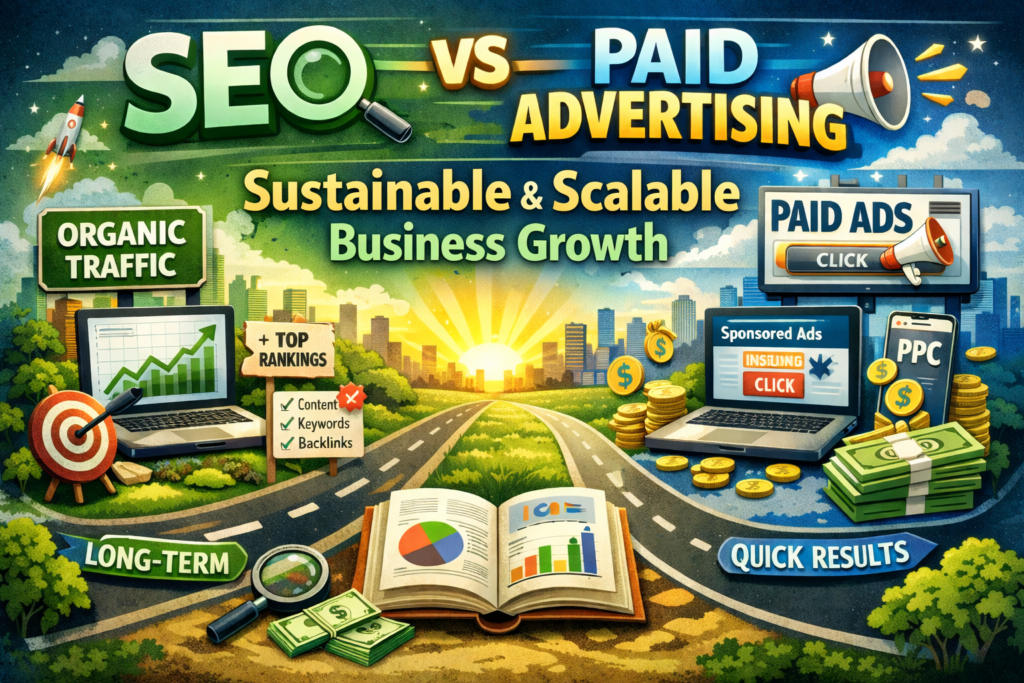
SEO vs Paid Advertising: Scalable Business Growth
Introduction: The Digital Visibility Dilemma
In today’s digital-first economy, visibility determines profitability. No matter how exceptional your
product or service may be, customers cannot buy from you if they cannot find you. This reality
forces businesses to answer one critical question:
Should we invest in Search Engine Optimization (SEO), Paid Advertising, or both?
Many business owners assume this is a simple choice between free traffic and paid traffic. SEO
and paid advertising are fundamentally different growth engines, each with unique strengths,
risks, timelines, and return profiles.
Understanding how these two strategies work—and how they complement one another—can
transform your marketing from reactive spending into a structured, scalable growth system.
This comprehensive guide explores the mechanics, advantages, disadvantages, cost structures,
risk factors, scalability, and long-term value of both SEO and paid advertising to help you make a
confident strategic decision.
Part 1: Understanding Search Engine Optimization (SEO)
What Is SEO?
Search Engine Optimization (SEO) is the strategic process of improving a website’s visibility in
organic (non-paid) search results on search engines like Google.
When users type queries into Google, they see two types of results:
Paid advertisements (sponsored listings)
Organic search results.
SEO focuses on ranking in the organic results section.
Unlike paid ads, SEO does not involve paying for clicks. Instead, it requires optimizing content,
website structure, and authority signals to earn higher rankings naturally.
How SEO Works
Search engines use complex algorithms to determine which pages appear for specific search
queries. While the exact algorithm remains confidential, major ranking factors include:
Keyword relevance
Content quality
Website speed
Mobile responsiveness
User experience
Backlinks (external website references)
Domain authority
Engagement metrics
SEO professionals analyze search intent and optimize websites accordingly.
The Three Core Pillars of SEO
1. On-Page SEO
On-page SEO involves optimizing elements directly within your website:
Title tags
Meta descriptions
Headers
Keyword placement
Internal linking
Image optimization
Proper on-page optimization ensures that search engines understand your content.
2. Technical SEO
Technical SEO improves backend website performance.
Site speed optimization
Secure HTTPS protocol
XML sitemaps
Craw lability
Structured data
Mobile optimization
3. Off-Page SEO
Off-page SEO focuses on authority building through backlinks.
When reputable websites link to your content, search engines interpret this as a trust signal. The
more high-quality backlinks you earn, the stronger your domain authority becomes.
Part 2: Benefits of SEO
1. Sustainable Long-Term Traffic
Once your website ranks well, traffic can continue flowing for months or years without additional
cost per click.
SEO builds digital assets that appreciate over time.
2. Higher Credibility and Trust
Ranking organically signals expertise and reliability.
Studies consistently show that many users skip ads and click organic listings instead.
3. Compounding Growth Effect
SEO works like compound interest. Each optimized article strengthens your domain authority.
Over time, ranking becomes easier for additional keywords.
4. Lower Long-Term Cost Per Acquisition
While SEO requires upfront investment, its long-term cost per lead or sale is typically lower than
paid advertising.
5. Competitive Advantage
Once established, strong SEO creates a defensive moat. Competitors cannot easily displace you
without significant effort.
Part 3: Limitations of SEO
Despite its advantages, SEO is not perfect.
Slow Results
SEO takes time. It may require 3–6 months or longer to see significant ranking improvements.
Algorithm Dependency:
Search engines frequently update algorithms, which can impact rankings.
Requires Expertise
Effective SEO demands technical skill, content strategy, and ongoing optimization.
Part 4: Understanding Paid Advertising:
What Is Paid Advertising?
Paid advertising involves promoting your business through sponsored placements on platforms
such as:
Google Ads
Meta Ads Manager.
Advertisers bid for placements and pay based on impressions, clicks, or conversions.
How Paid Advertising Works
Paid ads operate on auction systems. When users search for keywords, advertisers compete for
ad placement.
Ad ranking depends on:
Bid amount
Ad quality score
Relevance
Landing page experience
Higher quality ads can sometimes outperform higher bids.
Part 5: Types of Paid Advertising
Search Ads
Display Ads
Visual banner ads shown across websites.
Social Media Ads
Target users based on interests and behaviors.
Video Ads
Appear before or during videos.
Retargeting ads
Target users who previously visited your website.
Part 6: Benefits of Paid Advertising
1. Immediate Traffic
Once campaigns go live, traffic begins instantly.
This makes paid ads ideal for:
Product launches
Limited-time offers
Event promotions
2. Precise Targeting
Advertisers can target users based on:
Age
Location
Interests
Online behavior
Purchase intent.
This precision reduces wasted impressions.
3. Scalability
If a campaign performs well, you can increase the budget to scale results rapidly.
4. Predictable Growth
Paid ads allow businesses to forecast traffic based on budget allocation.
Part 7: Limitations of Paid Advertising
Traffic Stops When Budget Stops
The moment ad spending stops, visibility disappears.
Rising Costs
Competition increases cost-per-click over time.
Requires Continuous Optimization
Without proper monitoring, campaigns can waste budget quickly.
Part 8: Cost Comparison — SEO vs Paid Advertising
Factor SEO Paid Advertising
Initial Cost
Moderate to High
Flexible
Time to Results
Slow Immediate
Long-Term ROI High Variable
Traffic Stability Sustainable
Temporary
Scalability
Gradual
Instant
SEO builds long-term equity. Paid advertising buys temporary visibility.
Part 9: Strategic Integration — The Smart Approach
Phase 1: Use Paid Ads for Immediate Leads
While SEO builds momentum, paid ads generate early traffic and revenue.
Conclusion: The Balanced Growth Model
SEO builds assets. Paid advertising buys momentum.
SEO creates sustainable traffic. Paid advertising creates immediate opportunities.
The most resilient businesses combine both to create a balanced marketing ecosystem that
delivers short-term revenue and long-term stability.
Instead of asking which strategy is better, ask how to integrate both strategically.
That is how modern businesses win in competitive digital markets.